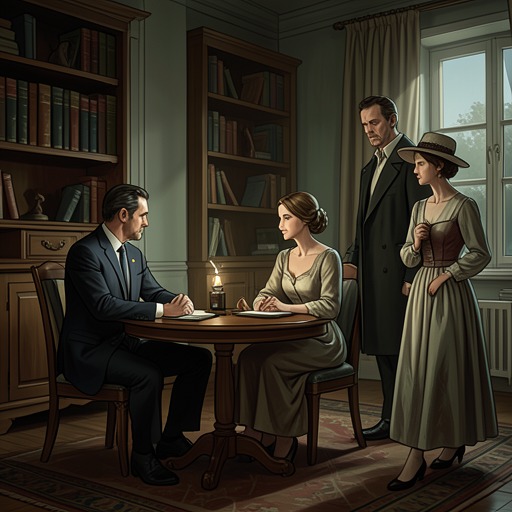
Mümtaz’s pearl earrings
The Museum of InnocenceMümtaz’s pearl earrings are a gift that carries more than their monetary value: they embody Kemal Basmacı’s father’s remorse for failing to show tenderness to a woman he once loved, and his warning to his son to treat women well before regret makes the lesson too late. Passed by the father to Kemal and then offered to Füsun, the earrings connect an old, unfinished love to the younger couple’s secret affair. Füsun’s refusal to wear them, and her suspicion that they are meant to replace her own lost earring, leave the gift’s emotional meaning unsettled.
Origin and the father’s remorse
During a conversation with Kemal, his father speaks of the woman he had lost with a regret sharpened by hindsight. He remembers her as charming, modest, and generous, and says that his suffering comes not only from losing her but from knowing that he failed to treat her as she deserved. His advice to Kemal is immediate and practical: women should be treated well now, not later, when it is too late to make amends.
The earrings give this confession a physical form. His father produces them from a faded, velvet-covered jewel box and recalls buying them at the Izmir Fair in the hope that the woman would forgive him. He never gave them to her; as he puts it, fate did not allow it. He has kept the pearls hidden for years, partly because he does not want Kemal’s mother to find them. Now he gives them to his son, proposing that Sibel wear them and that their sight remind Kemal both of him and of the lesson he has just delivered.
The instruction makes the jewelry a deliberately charged inheritance rather than a simple present. His father tells Kemal not to disclose the story behind the earrings to Sibel, who would then remain unaware of their earlier history. At the same time, he wants the memory of that history to stay with Kemal: the earrings should remain on Sibel’s ears while his father’s words remain in his son’s. The object is asked to carry a private memory without revealing it to its wearer.
From inheritance to gift
Kemal corrects his father when he calls Sibel his mistress, insisting that she is going to be his wife. The exchange places the intended recipient within the language of marriage, but the earrings soon follow a different route. After leaving his father, Kemal takes the velvet box to the Merhamet Apartments. Füsun arrives; they kiss, and he explains that the smell of spirits on him comes from lunch with his father. He then gives her the box.
When Füsun opens it carefully, she does not simply accept the pearls as an uncomplicated sign of affection. She says she could not wear them: they are very expensive, and people would want to know where they came from. Kemal answers that she need not wear them, but should not refuse the present. His offer thus separates possession from display. He wants her to accept the earrings even if she cannot publicly use them, while the social questions their expense might prompt make such a gift difficult for her to treat as private or ordinary.
Füsun identifies a more intimate complication. She says the earrings are a replacement for the one she left behind, and that if Kemal had not lost it, he would never have brought her these. She cannot know what he really did with her earring, or whether he truly lost it. Kemal assures her that it will turn up one day in a drawer at home, but the reassurance does not resolve her doubt. Her insistence that she wants her own earring distinguishes the missing object from the costly substitute: the pearls may be beautiful, yet they cannot restore the particular thing she believes she left with him.
An unresolved exchange
The scene briefly turns from the earrings to the prospect of Kemal visiting Füsun’s parents for supper. He promises that this will happen when he takes the tricycle to her house; she says she will wait to hear from him. They kiss again, and, as they begin making love, their troubles recede. The earrings, however, do not become part of that reconciliation: Kemal leaves his father’s pearls at the flat. The intimate moment therefore does not settle whether Füsun accepts the gift on Kemal’s terms, or whether he has answered her concern about the missing earring.
That unresolved exchange contrasts with the father’s intended use of the pearls. For him, they preserve a lesson about regret and the obligations attached to love; for Kemal, giving them to Füsun brings together his father’s story, the present affair, and the absent earring. For Füsun, the gift remains conspicuous and potentially compromising, and it cannot stand in for what she wants returned. The same object consequently means different things to its giver and recipient, exposing how affection can be offered through a possession without ensuring that it is understood or welcomed in the same way.
Objects, money, and remembrance
The later account of Kemal’s visits to the Keskin household provides a broader contrast in how he handles objects taken from Füsun’s family. He goes there four times a week under the euphemism of coming to “sit,” a routine of meals, television, conversation, and raki that allows him to spend time near Füsun without stating his principal reason for visiting. The earrings belong to an earlier, direct act of giving; in this later household routine, Kemal describes a change in his collecting practice: instead of replacing the things he takes, he begins leaving money. His care for objects and his exchanges with the family thus remain entangled with questions of value, permission, and compensation.
The pearls themselves are not a resolution. Their first intended recipient never received them, and Füsun does not treat them as an adequate replacement for her lost earring. Their movement instead preserves a chain of unfinished feeling: the father’s remorse passes to his son as a warning, then enters Kemal’s relationship with Füsun as a gift she questions. Their significance lies in that passage between people and meanings, not in any final act of wearing or reconciliation established by these scenes.